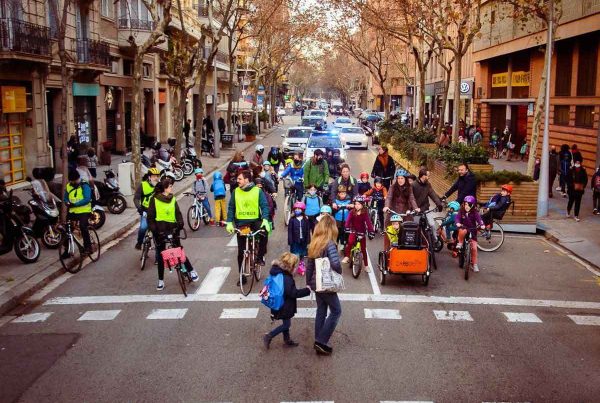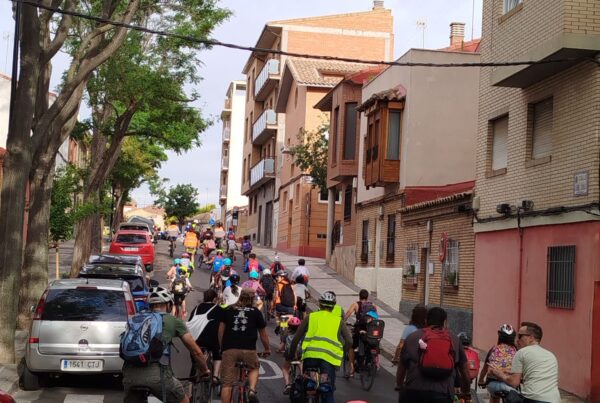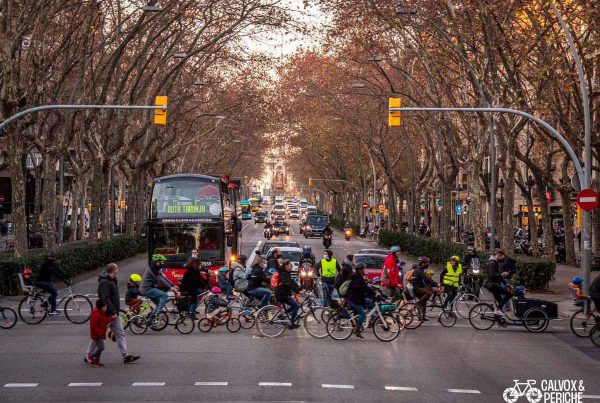
This week we launched a crowdsourcing effort with the aim of creating Barcelona’s first bicycle ridership model. Relying on dozens of volunteers, we hope to characterize who rides on different street types (high traffic, low traffic) with varying types of cycling infrastructure (protected, bidirectional, parking protected, or no infrastructure).
The project is led by BiciZen and the Bicicleta Club de Catalunya (BACC), with support from the Institute of Environmental Science and Technology (ICTA-UAB) and the Barcelona Supercomputing Center (BSC).
Bicicleta Club de Catalunya (BACC) is supporting our research team with the communication and outreach with the cycling community. Thanks to their network, over 30 people attended our online launch event on Monday October 28th 2024.
We have two sampling objectives. First, we want to know the demographic breakdown of who is riding on the sites with bicycle counters. The city has over 350 bicycle counters that are counting every bike lane users who crosses its path, and we have obtained this data on 15 minute intervals since 2017. While the counter data offers a detailed temporal resolution, the problem is that the counters do not distinguish between men, women or other genders, nor does it distinguish children and seniors from adults. We know that the presence of women, children and seniors signals that the cycling infrastructure is inclusive, and of higher quality. When we model cyclists, it is important to distinguish between the types of users, since many potential cyclists are excluded from the network because it is not perceived sufficiently safe or comfortable.
To address help us understand who is using bike lanes, we need real people (volunteers) to let us know the profile of the users. We will be using BiciZen, the free citizen science platform, that allows everyone to contribute the data to the same place.
Besides not being able to distinguish age and gender, the official counters have another problem. The city has installed them on main cycling avenues, with high traffic and better than average cycling infrastructure. From the perspective of the city, this makes sense, because they want to know if the higher quality infrastructure is being used. But from the perspective of creating a ridership model for the entire city, this placement is biased toward particular types of streets, and high use corridors. Since we aim to estimate bicycle ridership in all sorts of city streets, those with cycling infrastructure and those without, we need to sample in streets across all types of infrastructure types, especially in streets without cycling infrastructure. To fill in this gap, we selected the seven infrastructure types and randomly sampled two streets from each category.
When breaking down Barcelona’s streets according to cycling infrastructure, the largest number of streets fall into the ‘no-infrastructure’ category. So in this category, we sampled six streets, two with ‘high traffic’, two with ‘low traffic’ and two with ‘mid range traffic’. This produced six additional sample sites.
In total, we have 30 sample sites: 10 at locations of existing counters, 14 from streets with cycling infrastructure and 6 at sites without any cycling infrastructure.
We are working with a great team from the Barcelona Supercomputing Center, and well as essential guidance from Dr Mintu Miah.
Anyone interested in learning more about the project should contact Gerard Castilla at Gerard.Castilla@autonoma.cat
You can see our sample site locations here in the Spotteron platform.