Bicycle theft is often regarded as a minor urban nuisance. However, a closer look at the data reveals a far more consequential issue. Based on crime survey data, police reports, and bicycle ownership trends, researchers estimate that between 4 and 5 million bicycles are stolen each year across Europe—equivalent to approximately one theft every six seconds.
This figure likely understates the problem. A significant proportion of thefts go unreported, especially in contexts where victims perceive recovery to be unlikely. In high-cycling countries such as the Netherlands and Denmark, bicycle theft is widespread, but similar patterns are emerging in cities where cycling adoption is accelerating. The result is a substantial deterrent effect: the experience or fear of theft shapes travel behavior, discourages cycling uptake, and undermines investments in active mobility.
Despite the scale and consequences of bicycle theft, academic attention has been disproportionately low. An analysis of publication trends using Web of Science data illustrates this gap. From 2000 to 2010, the number of academic articles referencing “bicycle infrastructure” averaged approximately 10 per year. By 2024, this had grown twenty-fourfold to 273 publications. In contrast, research focusing on “bicycle theft” has remained stagnant, averaging just 11 publications per year over the last decade.
This asymmetry matters. While infrastructure investments are crucial, their benefits are undermined when users do not feel secure parking or using bicycles. Fear of theft influences bicycle ownership decisions, the choice of routes and destinations, and long-term mobility patterns—especially for users of high-value bikes such as e-bikes or cargo bikes.
This fall we City Lab Barcelona will host Quinn Gregory, a Fulbright Fellow, who will be working on the topic of bicycle theft. We look forward to working with him on this topic. Through our research on bicycle theft, we aim to inform data-driven prevention strategies, and bring more attention to this neglected barrier to sustainable mobility.
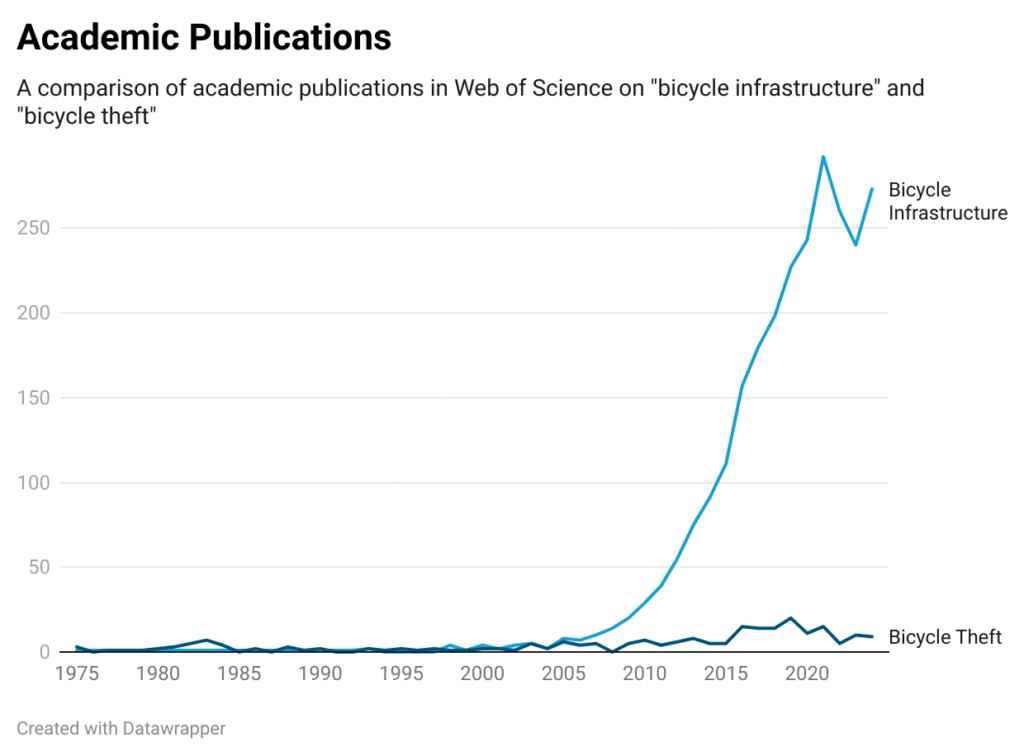
Research on the bicycle as everyday mobility has grown 10-fold in the last 15 years with most attention devoted to the creation of cycling infrastructure and safety.